
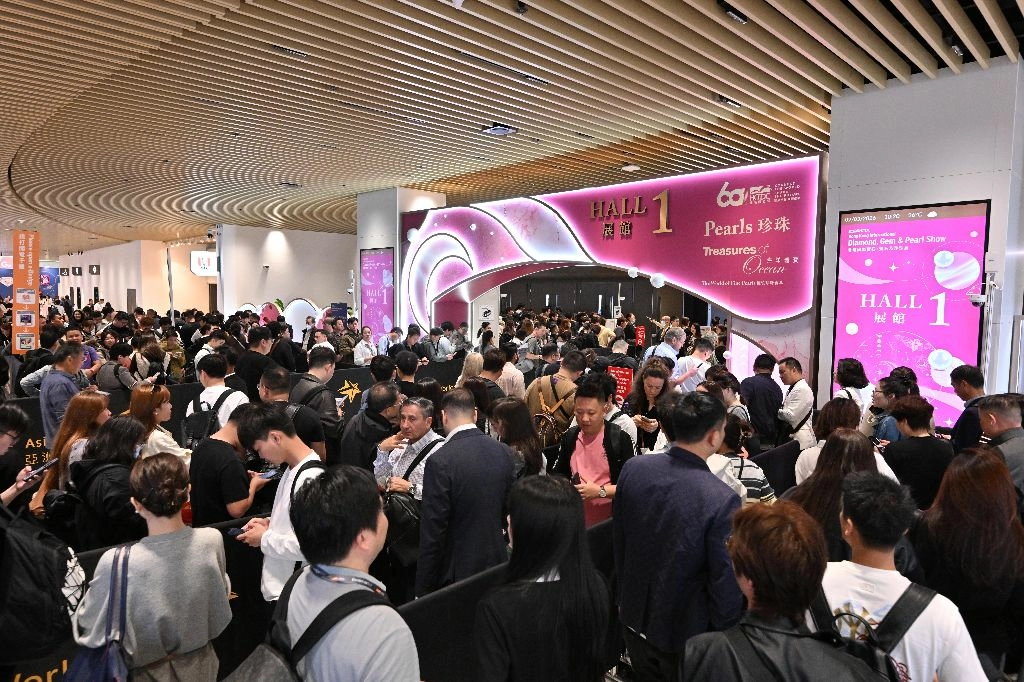
The HKTDC Hong Kong Twin Jewellery Shows offer jewellery industry professionals from around the world an opportunity to connect, explore business opportunities and strengthen industry relationships. For buyers, the shows are a global platform to explore new collections, discover emerging trends, reconnect with existing suppliers as well as explore new manufacturers and producers. For exhibitors, the shows offer access to an international audience and opportunities to expand into new markets.
Canadian Buyers
To gain a Canadian buyer’s perspective on the March 2026 HKTDC Twin Jewellery Shows. I spoke with Anita Agarwal of Best Bargains Jewellery and Arka Akkelian of Nishi Pearls about their experiences, key takeaways and observations from the events.
Their insights offer a valuable glimpse into what makes the HKTDC Twin Jewellery Shows an important destination for Canadian buyers.


Anita Agarwal at Best Bargains Jewellery, Toronto
Anita Agarwal is the CEO of Canadian jewellery company Best Bargains, and has been an integral part of the North American jewellery industry for over three decades. She is a multi-award-winning jewellery designer and presents her designs under her two brands, Jewels 4 Ever™ and Jewels by Anita™. Through Jewels 4 Ever™, Agarwal offers an affordable line of fine jewellery while her Jewels by Anita™ brand caters to clients seeking her bespoke pieces.

What were your primary objectives going into the HKTDC shows this year, and were they met?
Anita Agarwal : My objectives were to see what new products were out there, what new styles existed and to find some promotional items as we are celebrating 35 yrs in the jewellery industry.
Which product categories or materials stood out most to you this year at the Twin Jewellery shows? Did you notice any major shifts in buying trends compared to previous years?
Anita Agarwal : I was attending the Hong Kong jewellery shows since 1995, but had not been back since 2019. After a gap of seven years, I noticed quite a huge difference in many areas:
- There were very few North Americans and Europeans at the show. Most buyers were from Asia. I believe this change reflects the current state of the world especially due to the unpredictability of trade relations with the US. Additionally, the overall lower consumer spending has also bifurcated our industry – there are a lot of both higher-end consumers and lower-end consumers. The mid-level consumers are either saving their income wherever they can, or altering their consumer behaviour to lower end pieces. Also, I think that Asia overall – whether it’s Indonesia, China, India, Cambodia, Philippines, Vietnam or Bangladesh – is moving up. There are many more middle class consumers in these countries than a decade ago. Asia is where it’s at!
- Many of the mid- to lower-tier companies that manufactured in silver were offering alternative metals, including brass, gold-filled alloys and steel, which was unheard of before because precious metal manufacturers used to stick to precious metal. Because of this shift to different metals, the prices were all over the place. You could find something for $4 at one vendor and the exact same thing at another vendor for $21. It’s because these vendors are not used to producing in alternative metals. So I had to search around a lot for the pieces I wanted for fair prices.
- Vendors were willing to lower their MOQ’s. I remember in the 90’s and up until 2019, most low-cost vendors would require a MOQ of 100 units per model. There were very few companies who would sell you smaller quantities. This wasn’t because companies are doing poorly when they have high MOQs, in fact what impressed me was the expediency and efficiency of the overall manufacturing process. In addition, Chinese and Hong Kong-based vendors have found cheaper and more efficient ways to ship, which has also helped with the lower MOQs.
- Direct-to-consumer selling. What really surprised me at the show was that while vendors had their booths, they also were selling live on social media platforms, and were doing business right there and then.
What are your thoughts on the Two-Shows, Two-Venues set-up of the shows? How would you describe the overall organization, logistics and visitor experience of a buyer coming from Canada?
Anita Agarwal : I’ve done these trade shows for over 3 decades now, and I find that it’s totally fine. One show is for supplies and gemstones and the other for manufactured goods. What I love the most is the ease of transportation with the buses after the show. So whether you are staying in Kowloon or Hong Kong, you can easily find a shuttle bus to take you to your location and then figure out the logistics after being dropped off to a convenient location. However, both shows are huge! I spent two full days at each show and it was not enough for me. I definitely missed a few halls. Also, I can’t emphasize how much walking you need to do to get around just as a buyer. But it was worth it!
With pavilions from many different countries, did you find yourself diversifying your suppliers? Also, were you easily able to find suppliers that matched your quality, price and reliability expectations?
Anita Agarwal : I already have a very strong supply chain globally, having been in the industry for 35 yrs. However, for sure, I did find new suppliers. For the first time I was able to source some display materials and new tools directly at the show. Given the high price of precious metals (yes, the prices have gone up), even so, the prices and quality at the show were overall great.
I find pieces in my collection from the 1990s, but I’ll tell you that the quality of pieces produced in various Asian countries has surpassed all expectations. Even most of my favorite designers like Austy Lee and Wallace Chan are based out of Hong Kong.
How did the global and Canadian economic conditions affect your buying strategy? Did attending the HKTDC Twin Jewellery Shows help in any way?
Anita Agarwal : The nice thing about the twin shows is the very wide range of suppliers and products. As a Canadian buyer, I was also able to place orders for new silver items and gold plated alloy as well as gold filled pieces. I was also able to comparison shop and, as a manufacturer and award-winning jewellery designer, source gemstones easily from suppliers around the world .
Did anything about the HKTDC Twin Jewellery shows surprise you?
Anita Agarwal : Language used to be a barrier in the past. However, now with instant AI translation apps and with the way Asian companies are using technology to send fast quotations, the workflow is very smooth. No more waiting around for 2 weeks for a purchase order. In fact, the turn around time is less than 24 hours now in many cases. This speaks to the kind of effective inventory and production management systems that these companies have put in place.


Arka Akkelian at Nishi Pearls, Montreal
Arka Akkelian is the Co-founder and International Operations Director of Nishi Pearls, a Canadian pearl jewellery company he established with his sister, Alique Akkelian. A fourth-generation jeweller and pearl dealer, Akkelian and his siter have sought to give pearl jewellery a contemporary appeal through Nishi Pearls, by reimagining this classic gem for a younger generation while maintaining a focus on quality, craftsmanship and versatility. Akkelian is also associated with Canadian Gem, and currently serves on the board of the Canadian Jewellers Association.

What were your key objectives for attending the HKTDC shows this year?
Arka Akkelian: We attend the Hong Kong show for various reasons. Since we are in the pearl jewellery business, this is where we meet most of our pearl suppliers and pearl jewellery factories in one place. We sort through loose pearl material, select pearls and decide on new jewellery styles that we would like to propose to our clients in North America. There are also pearl auctions organized around the show dates that we participate, and these are an important part of securing the material we require. Lastly, we have a small sourcing office in Hong Kong so this is an occasion to re-organise and re-align goals and priorities.
How did the HKTDC Twin Jewellery shows compare to the other international jewellery trade events you have attended recently?
Arka Akkelian: It is one of the biggest, most well-organised shows, and for us, one of the most important events of the year. There are other similar conventions in other Asian countries that I also enjoy attending, such as the Bangkok Gems & Jewelry fair, but most of those end up having mostly local suppliers as exhibitors, whereas the Hong Kong show draws an international crowd of both exhibitors and attendees.
Did you notice any shifts in availability or quality across key pearl types (freshwater, Akoya, South Sea, Tahitian)?
Arka Akkelian: Yes. All pearl types are becoming less available. COVID played a role in this because seeding pearls in oysters is a specialized craft and with travel restrictions, these specialized seeders were not able to travel to the various farms in various countries and therefore less oysters were nucleated and put in the water. We are now in the 1-3 year window post-COVID where the pearls that were seeded in that period are being harvested, but there are less pearls to harvest. With demand being fairly constant overall, this has pushed prices higher.
Freshwater pearls are also going through an important structural change whereby they are now being nucleated the same way Akoya or South Seas are. The process is fairly new but once this becomes more common and mainstream, we expect to see more round white freshwater pearls.
How important is supplier transparency, such as origin, farming practices, and treatments, when selecting pearl vendors at a jewellery show today? Are your Canadian customers asking more questions about origin, sustainability and ethical production when it comes to pearls?
Arka Akkelian: The customers are not asking more questions specifically about pearls but in general this has become more important to all of us in society and therefore we at Canadian Gem / Nishi Pearls consider this as an important factor when selecting which partners to work with.
Last year, at the end of September 2025, I visited Zhuji province in China where a lot of the freshwater pearls are harvested. I visited various factories and farms of suppliers we deal with and witnessed first hand the working conditions and techniques used. I have also found that suppliers are more transparent now. They pride themselves in showing their facilities and processes to clients (us) which I believe is the right way of doing business. When a company knows that they bring value to the table, they are not afraid to explain and show their methods and processes. This transparency is at the heart and at the start of any discussion about origin and sustainability.
What design trends, product innovations or styles caught your attention at the shows? Did the shows help you identify any new pearl trends?
Arka Akkelian: The freshwater pearl nucleation process change to me was most notable which will bring rounder and larger freshwater pearls to the market that I think will end up challenging their saltwater counterparts.
HKTDC has promoted its new, online “Scan2Match” and “Click2Match” AI tools this year. Did these streamline your sourcing process, or do you still find traditional face-to-face negotiation more effective?
Arka Akkelian: One of the main reasons I am at the show is for the face to face interactions. This is especially true for us who are lucky enough to have a local presence in Hong Kong.
That being said, we do still use these services and we find it is quite useful when looking for a specific product or service that you do not work with on a regular basis. This year for example we were looking for suppliers that sell base metal (steel, brass etc) pearl jewellery. The matching services played a key role in exploring options and making new contacts.
What was the most unexpected thing you learned by attending the March HKTDC Hong Kong Jewellery Shows?
Arka Akkelian: That I really enjoy good Dim Sum 🙂
Canadian Exhibitors
There were two Canadian exhibitors at the HKTDC Hong Kong Twin Jewellery Shows in March 2026. One of them was KORITE, a brand renowned for its Canadian ammolites and fine jewellery.
KORITE

Based in Alberta, KORITE specialises in ammolite, both as loose gem material and in finished fine jewellery. Established in 1979, the brand has brought the extraordinary beauty of ammolite to the international market.
Formed within the fossilised shells of ancient ammonites, ammolites are coveted for their vibrant colours, shimmering iridescence and distinctive patterns. Each ammolite is unique, displaying its own distinctive combinations of colours and patterns.
Renowned for its ethical mining practices, KORITE’s operations in Alberta also include the selection, processing and handcrafting of this unusual gem material into loose cabochons and finished fine jewellery.
At the March 2026 HKTDC Diamond, Gem & Pearl show, KORITE not only showcased this Canadian gemstone at its exhibitor booth, but also debuted a one-of-a-kind, 18K gold necklace featuring AA-grade ammolite and diamonds!
Featured Image: At the Hall of Extraordinary, HKTDC Hong Kong International Jewellery Show 2026.
