
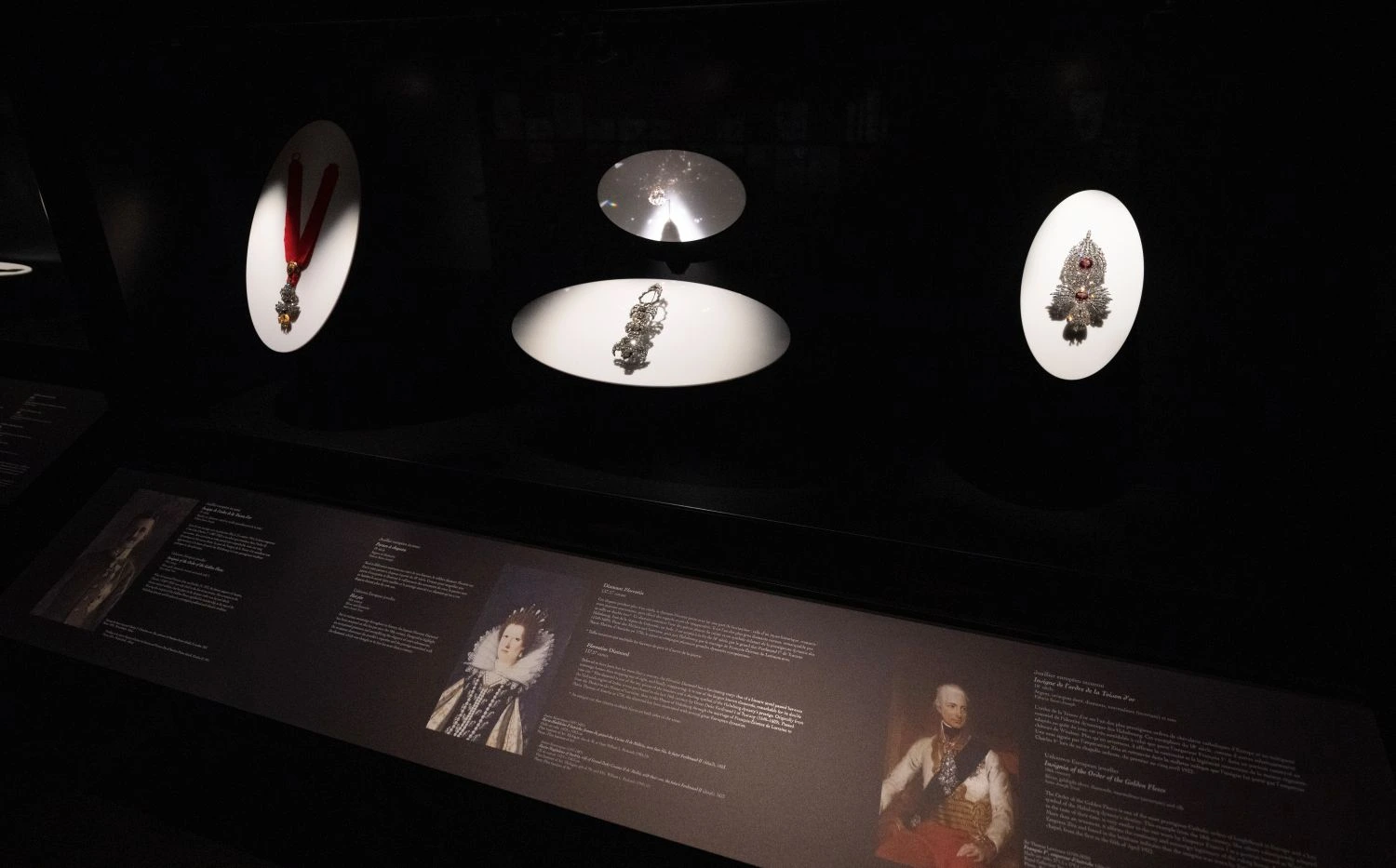
For decades, a hidden treasure sat in a secure bank vault in Québec City. Only a handful of people knew of its existence and whereabouts. Bound by a promise of secrecy, they kept the treasure concealed until its existence was finally revealed to the public in 2025.
Hidden Treasure: A Century of Mystery is an exhibition showcasing this secret treasure, which consists of 15 prestigious jewels associated with the Habsburg family. Presented by the Musée national des beaux-arts du Québec (MNBAQ), the exhibition goes beyond showcasing exceptional jewels of both royal provenance and historical significance. It also tells the story of a family’s experience of exile and Québec City’s place in that history.
Among the jewels is the 137-carat Florentine Diamond, one of the largest known diamonds, which was believed to have been lost for nearly a century. There are also pieces of immense personal relevance to the Habsburgs, such as Marie Antoinette’s pocket watch. This piece sits at the intersection of fine jewellery-making and fine horology while carrying rich historical and cultural resonance.
“We are incredibly proud to be presenting Hidden Treasure: A Century of Mystery at the Musée given the jewels’ close ties to the history of the city of Québec, where they were kept in secret for decades,” observes Musée national des beaux-arts du Québec Director General Jean-Luc Murray. “For the very first time, we are inviting the public to see these extraordinary masterpieces of European jewellery, whose brilliance, elegance, and story echo through history.”
Royalty in Exile and the Habsburg Jewels

Villa Saint-Joseph in Sillery, c. 1945. Otto Von Habsburg Foundation (HOAL 15B 15-36) // Unknown photographer 
Empress Zita surrounded by six of her children in front of Villa Saint-Joseph, in Sillery, 1945 // Photo: Courtesy of Darius Consulting GMBH 
Members of the imperial family enjoying winter sports, c. 1945. Otto Von Habsburg Foundation (HOAL 15B 15-36) // Unknown photographer 
Jack Braylay, « In the imperial family of Austria-Hungary » Le Soleil, May 28th, 1943, p. 3. Bibliothèque et Archives nationales du Québec (0004878815) 
Unknown, «The imperial family. Empress Zita and her children at the Villa Saint-Joseph in Bergerville, near Quebec City. », L ’Action catholique, December 8th, 1940, p. 2. Bibliothèque et Archives nationales du Québec (0000169215) 
Emperor Charles I and Empress Zita with their son Otto, crowned king and queen of Hungary, 1916 // Photo: Heinrich Schuhmann – Wikimedia Commons
After the collapse of the Austro-Hungarian Empire at the end of the First World War in 1918, Emperor Charles I of Austria (who was also King Charles IV of Hungary) and his wife Zita, the last Empress of Austria (and Queen of Hungary), went into exile. More than two decades later, as the Second World War engulfed Europe, Zita and her family fled the advancing Nazi forces and sought refuge in Québec City, settling at Villa Saint-Joseph in Sillery.
“In Québec City, the Habsburgs led a happy and active life, with the children often going skiing or participating in other winter sports, just like other children,” explains Murray, describing the family’s life in Canada during their years in exile.
What very few people knew was that the Empress had brought a collection of jewels with her to Canada. This hidden treasure would remain concealed in Québec for decades, creating a lasting bond between Zita’s family and the city where they found refuge.
“The city of Québec offered my family safety, respect, and hope during a time of great uncertainty,” explains Empress Zita’s grandson, Karl von Habsburg. “Showing these jewels at the Musée is an expression of profound gratitude to Québec and Canada for welcoming and sheltering my grandmother and her eight children during World War II.”
The Story of a Briefcase with a Secret

The Hidden Treasure exhibition has been organised by the MNBAQ in collaboration with the Saint Joseph Trust. Before returning to Europe after the end of the Second World War, Empress Zita entrusted the briefcase containing the jewels to the Saint Joseph Trust, which kept the tresure in its custody in a secure bank vault in Québec City.
“In 1940, Québec and Canada welcomed the Habsburg family during a time of great uncertainty. That generosity left a deep impression on the family and has never been forgotten. More than 80 years later, it is deeply moving to see this story continue in Québec and to be able, in turn, to share these treasures with the public. We are proud to help preserve them and pass on their story to future generations,” explains Andrew Molson, trustee of the Saint Joseph Trust.
Before the exhibition could be planned and designed, the MNBAQ team had to familiarise itself with the jewels. To facilitate this, Molson and his team brought the briefcase to the MNBAQ, where he broke its official Habsburg seal and opened it for the first time in almost eight decades.
“The briefcase itself is very small. What is extremely touching is that such a humble object stored such an exceptional treasure and that it was in the same state that Zita left it,” notes Murray. “Opening the case was a really moving experience for our teams. Inside it, the jewellery pieces were stored in small envelopes or silk pouches with simple notes such as ‘given to my child by the Pope’. In fact, the Florentine Diamond was stored in a small envelope that simply said ‘Florentine’,” Murray describes.
Since the pieces had been hidden in a bank vault for decades, several had to be cleaned and repaired before they could be presented to the public. “There’s a beautiful brooch that belonged to Empress Sisi, which had large yellow sapphires representing the colours of the Austro-Hungarian empire. When we found it, some of its parts were detached, so it had to be repaired,” Murray explains.
Hidden Treasure – A Three-Part Journey
The exhibition is divided into three parts.
In the first part, visitors learn about some important historical milestones in the story of the Habsburg family, such as the marriage of Charles Habsburg-Lorraine to Zita of Bourbon-Parma, their unexpected ascension to the throne, the collapse of the Austro-Hungarian Empire, and the years of exile that brought Zita and her children to Québec City.
“What was interesting was that the people of Québec were following the story of Charles and Zita, from the time of their marriage to their exile after the fall of the empire. When they arrived in Québec City, they were already well-known,” explains Murray, referring to the newspaper articles published in Québec City as well as Montréal even before the family’s arrival in Canada.
In the next part, the exhibition ties the story of the imperial family to works and objects associated with Québec. The focus then narrows to Zita and her family’s life in Québec City, the mystery of the ‘hidden treasure’ and how this secret was passed down from one generation to the next.
Finally, in the third part, the journey concludes with the display of the 15 royal jewels themselves, as well as the briefcase that protected them for decades.
“The exhibition was designed in a way that would help the visitors connect with the story of the jewels, the Habsburg family, and the part Québec City played in their lives. Many people were very moved by the exhibition, and I received emails from many of them in which they shared their experiences,” Murray recounts.
Key Pieces in the Collection
Among the 15 jewels, the following pieces are of immense cultural and historical significance, offering fascinating insights into the art of fine jewellery, fine horology and the world of gemmology.
Insignia of the Order of the Golden Fleece

The Insignia of the Order of the Golden Fleece is one of Europe’s most prestigious orders of chivalry. As such, it is an integral part of the Habsburg dynasty’s identity. This particular piece dates to the 18th century and was displayed on Charles I’s body at his wake. It was crafted in silver, gold or gilt silver, diamonds, and silk. The red gemstones have been identified as possibly being tourmalines.
More than a magnificent, jewelled ornament, this medallion symbolizes the Habsburg dynasty’s historical ties to Catholicism.
Queen Marie Antoinette’s Pocket Watch

This exquisite accessory was part of Marie Antoinette’s (1755-1793) trousseau for her marriage to Louis XVI, King of France. Placed in safekeeping during the French Revolution, the pocket watch was later returned to Marie Antoinette’s daughter, Marie-Thérèse (1778-1851), for her marriage.
This pocket watch, made circa 1770 by renowned French watchmaker Jean-Antoine Lépine, was crafted from silver, ferrous alloy, diamonds, glass, enamel, and enamel powder. It was further embellished with vivid pink gemstones, believed to be pink sapphires.
However, it is the detail on the reverse of the watch that gives this piece a deeply personal dimension: a lock of hair, perhaps belonging to Marie Antoinette’s mother, Empress Maria Theresa of Austria.
The Florentine Diamond


The centrepiece of the exhibition is the Florentine Diamond. This 137-carat gem was one of the emblems of the Habsburg dynasty’s power and prestige and was believed to have been lost for many years.
It has a light yellow colour of exceptional purity, and its double rose-cut adds another layer of faceting to its underside. Its 126 facets create a mesmerising display of sparkle and brilliance.
The Florentine Diamond made its way through centuries of history and through several European courts before becoming part of the Austrian Crown Jewels in the 1740s. Since then, it has been set in different jewellery pieces, the last of which was a silver and diamond hat pin. It was in this setting that the diamond was recovered from the vault.
“For the purpose of the exhibition, we have presented the diamond separately on a support, while the hat pin on which it was mounted is displayed in the same exhibit,” explains Murray.


In addition to these notable pieces, the exhibition also includes Empress Sisi’s yellow sapphire brooch/hat pin, and a diamond and pearl brooch credited to A. E. Köchert, one of the oldest jewellers in Austria.
The exhibition also features an impressive emerald and diamond pocket watch. “My personal favourite jewel from this collection is the emerald watch. What is particularly mind-boggling is the way the carved emerald serves as a housing for the watch case. In a world where we are surrounded by cheap objects that do not last, this watch stands apart for its craftsmanship and uniqueness,” Murray observes.
Curating the Hidden Treasure Exhibition


The team at the MNBAQ took on the Hidden Treasure project in the autumn of 2025, and the museum inaugurated the exhibition in September 2026. “This was not an easy project. The jewels had been left in a briefcase for about 80 years, and many had to be expertly repaired and cleaned,” Murray notes. “The exhibition also had to be researched, designed and planned, all of which took time. At the same time, the opening of the Espace Riopelle – Michael Audain Pavilion at the Musée national des beaux-arts du Québec was scheduled for October 2026. So, a lot was happening at the museum.”
The exhibition opened on September 4, 2026, and has attracted thousands of visitors from all over the world.
“Québec is proud to share this extraordinary story with the public and to welcome to the MNBAQ a collection of remarkable historical significance,” says Mathieu Lacombe, Québec’s Minister of Culture and Communications. “Bringing these treasures to light creates a striking dialogue between heritage, memory and human resilience.”
You can learn more about Hidden Treasure: A Century of Mystery at the the Musée national des beaux-arts du Québec.
The Hidden Treasure: A Century of Mystery exhibition was designed and produced by the Musée national des beaux-arts du Québec (MNBAQ), in collaboration with the Saint Joseph Trust. The exhibition is supported by the Government of Québec. The Habsburg family also lent their support and cooperation in making this exhibition possible.
Featured Image: View of the exhibition Hidden Treasure: A Century of Mystery at the Musée national des beaux-arts du Québec // Photo: MNBAQ, David Cannon
