
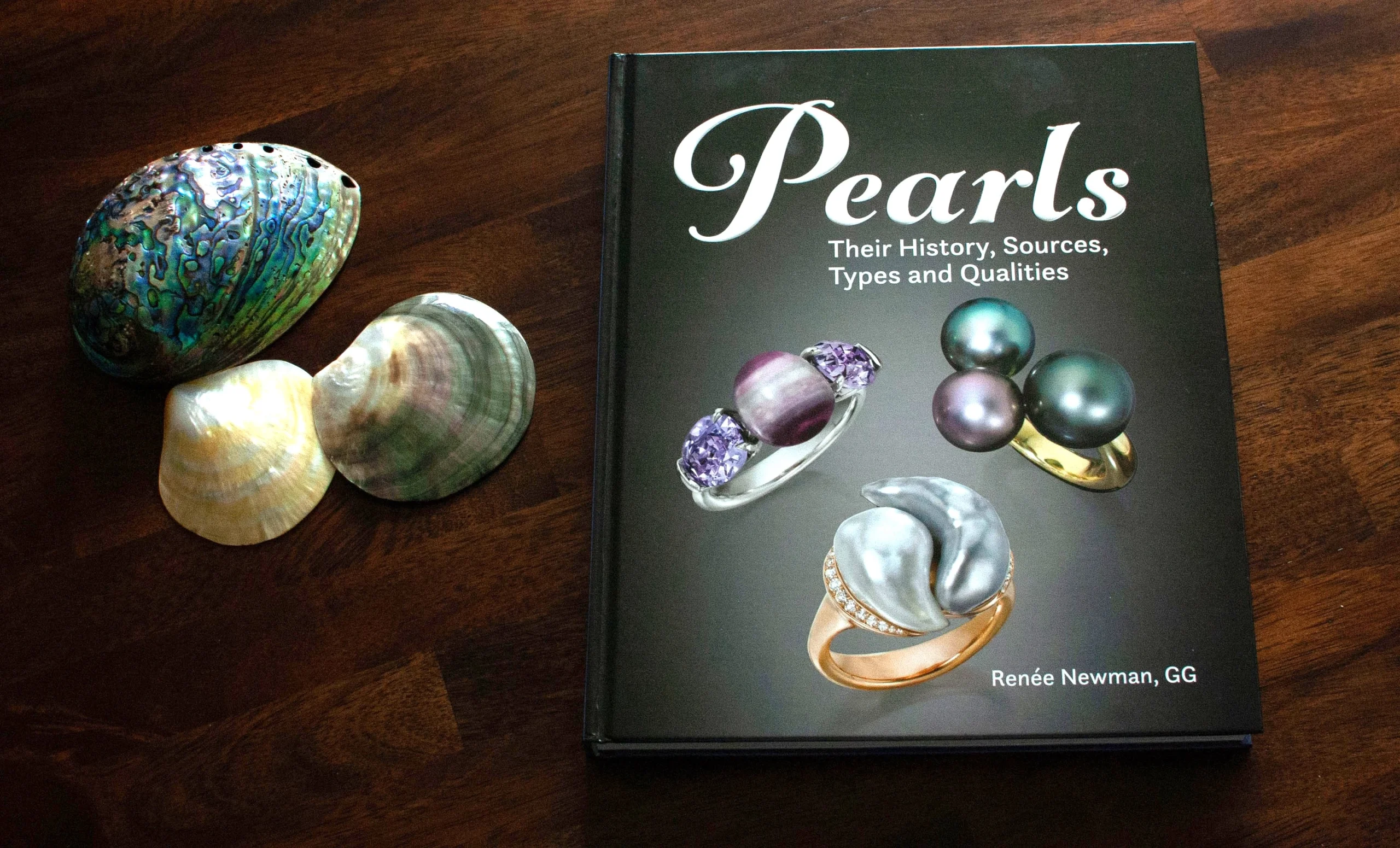
As a gem category, pearls have both fascinated and sometimes daunted jewellery lovers. The fascination is easy to explain. What can feel daunting, however, is despite being the oldest gem known, there is a lot about pearls that is not widely known or understood.
Cultured or natural, nacreous or porcellaneous, grades, classifications, treatments… the list goes on. Pearls: Their History, Sources, Types and Qualities by Renée Newman takes on this challenge with clarity and ease, offering a comprehensive and engaging exploration of the world of pearls.
About the Author Renée Newman
Renée Newman is a highly respected gemmologist, writer, lecturer and author of 16 books on gems and jewellery. She is a Graduate Gemologist (G.G.) from the Gemological Institute of America (GIA). Her books are widely used as reference texts in the jewellery industry and are valued for their structured explanations, detailed visuals, and practical insights. Newman gathers the information for her books through her interviews with gem dealers, jewellers, appraisers, and gem laboratories. She stays current by attending trade seminars and gem shows. At the same time, her perspective is further enriched by insights from consumers and hobbyists.

A Book That Makes Pearls Accessible
Pearls is a well-structured and highly readable book. Although best read from cover to cover for a fully immersive experience, the book’s well-structured format allows readers to explore individual sections without losing clarity or coherence.
Divided into 13 chapters, the book is further organized into sections, each focusing on a single aspect or attribute of pearls. Thus, while the book brims with information, the reader is able to follow it without being overwhelmed. What’s more, the reader can pause mid-chapter and return to it with ease, without losing their place or sense of continuity.
The book’s strong visual appeal and exceptional selection of images and illustrations serve two distinct purposes. On the one hand, they are used to support and explain the text; an abstract concept is brought to life through a relevant image or illustration. On the other hand, they are also very eye-catching and striking. Readers are drawn to the quality and colours of the images, thus adding to their reading pleasure. Many of the images are credited to Newman herself, which underscores her hands-on experience with gems and jewellery.
An important feature of this book are the text boxes that appear frequently in the margins and highlight key concepts or facts, explaining them further. This not only highlights Newman’s knowledge of the topics but also her intuitive understanding of her readers, and the topics they would like to explore in greater depth.
For instance, a text box in Chapter 2 explains pearl iridescence alongside the introduction to nacre in the chapter. Without this additional explanation, many readers would find it difficult to understand the link between nacre and iridescence.
Since this is a reference text, it cites all primary and secondary research throughout the book along with a comprehensive bibliography and list of additional sources in the appendix.


Pearl Value Factors and the Evaluation of Pearls
Newman has dedicated an entire chapter to pearl value factors, providing detailed and highly instructive guidance. Each value factor is examined both individually and in relation to the others. As a result, the reader gains a clearer understanding of both the individual components and the overall framework of how pearls are valued and priced in the jewellery market.
Newman’s ‘Tips on Judging’ the different value factors, from a buyer’s perspective are truly remarkable, offering expert insights that are clear, practical and actionable. For instance, one such section, ‘How Lighting Affects Color’ is a masterclass in evaluating pearl colour in different lighting conditions and clearly outlines the ideal conditions for assessing pearl colour and lustre.
Understanding Different Types of Pearls
The book also devotes separate chapters to the different types of cultured and natural pearls. In each chapter, the different pearl types are discussed in detail, covering their biology, origin, and price factors that affect their value.
However, there is also an entire chapter devoted to imitation pearls which, again is very informative. But at the end of that chapter, Newman’s observation about imitation, cultured and natural pearls, clearly states a universal truth about the world of pearls. “Distinguishing imitations from real oyster pearls is not difficult; even laypeople can learn how to detect imitations with a 10-times magnifier, but it takes practice. It is more challenging to distinguish cultured pearls from those that are natural.”

A Closer Look at Pearl Processing and Treatment
Another important section of the book focuses on pearl processing and treatment. Newman explains how pearls may be processed or enhanced after harvesting, and how these practices influence both appearance and value.
Readers without a technical background in pearls as well as those already familiar with gemmology will find this chapter highly informative. By breaking down each process in a straightforward way, Newman offers a true behind-the-scenes look at the treatment some pearls may undergo before they reach the market.
The chapter also highlights various methods used to detect many of the treatments. Many pearl buyers are unaware of pearl processing and treatments. This chapter, therefore, adds another important layer to the book’s practical and educational value.
Pearls in Jewellery Through Time
Another important chapter explores pearl jewellery across different jewellery eras. In this chapter, readers are introduced not only to various periods and styles of jewellery, but also to the way pearls, both cultured and natural, featured in the designs of each era, situating the gem within a broader cultural and historical context, beyond its role as an adornment. The chapter is enriched by exceptional images of both period and contemporary pearl jewellery, making it as rewarding to peruse through, as it is to learn from.

A Writing Style That Brings Pearls to Life
Newman’s writing is a pleasure to read. Her style is erudite yet very engaging, which is a difficult feat. But even more than that, it is thought-provoking. For instance, while explaining lustre, Newman notes, “If all the pearls in the world were lined up according to the quality of their luster, from high to low, the degree of luster would change very gradually and there would be no distinct categories” (Chapter 3). The writing is visually and intellectually engaging, and encourages the reader to consider lustre, an important value factor of pearls, along a continuum rather than as a stand-alone attribute.
Why Pearls Belongs on Every Pearl Lover’s Bookshelf
Pearls: Their History, Sources, Types and Qualities by Renée Newman is for everyone. From novice jewellery lovers to industry professionals, every reader will gain a deeper understanding, fresh insights, and greater appreciation for this lustrous gem. With its clarity and depth, it firmly establishes itself as an essential reference text and leaves its reader not only better informed, but also with a renewed sense of admiration for the quiet complexity of this enduring gem.
You can learn more about Renée Newman, Graduate Gemologist on her website
You can purchase Pearls: Their History, Sources, Types and Qualities here
Pearls: Their History, Sources, Types and Qualities by Renée Newman was published by Firefly Books on October 15, 2025, in a hardcover format.
