
Late last year, a group of Key Opinion Leaders (KOL), guests of the Pearl Association of America and Japan Pearl Exporters Association, embarked on an exciting tour of working Akoya pearl farms in southern Japan.
This included a visit to the Nagasaki Prefecture, an important pearl growing region of Japan. An important industry in Japan, Akoya pearl farming has historical roots going back more than a hundred years, when Kokichi Mikimoto cultivated the first spherical Akoya pearl.
It is rare for those outside the Japanese pearl industry to visit a working pearl farm, making this tour especially thrilling for me. As a pearl enthusiast, it was a once-in-a-lifetime opportunity to experience an authentic, behind-the-scenes view of a pearl farm.
Kitamura Pearls

Early morning at the Kitamura Pearl Farm 
On our way to see the buoys 
Oyster panel net with Akoya oysters 
Closer look at a 2 year old Akoya oyster 
Opening a basket of very young, 8 month old Akoya oysters 
Two young oysters clinging to each other 
Another basket of Akoya oysters 
Statue honouring the Akoya pearl oysters who give their lives in order to produce beautiful pearls 
Another view of the Kitamura Pearl Farm
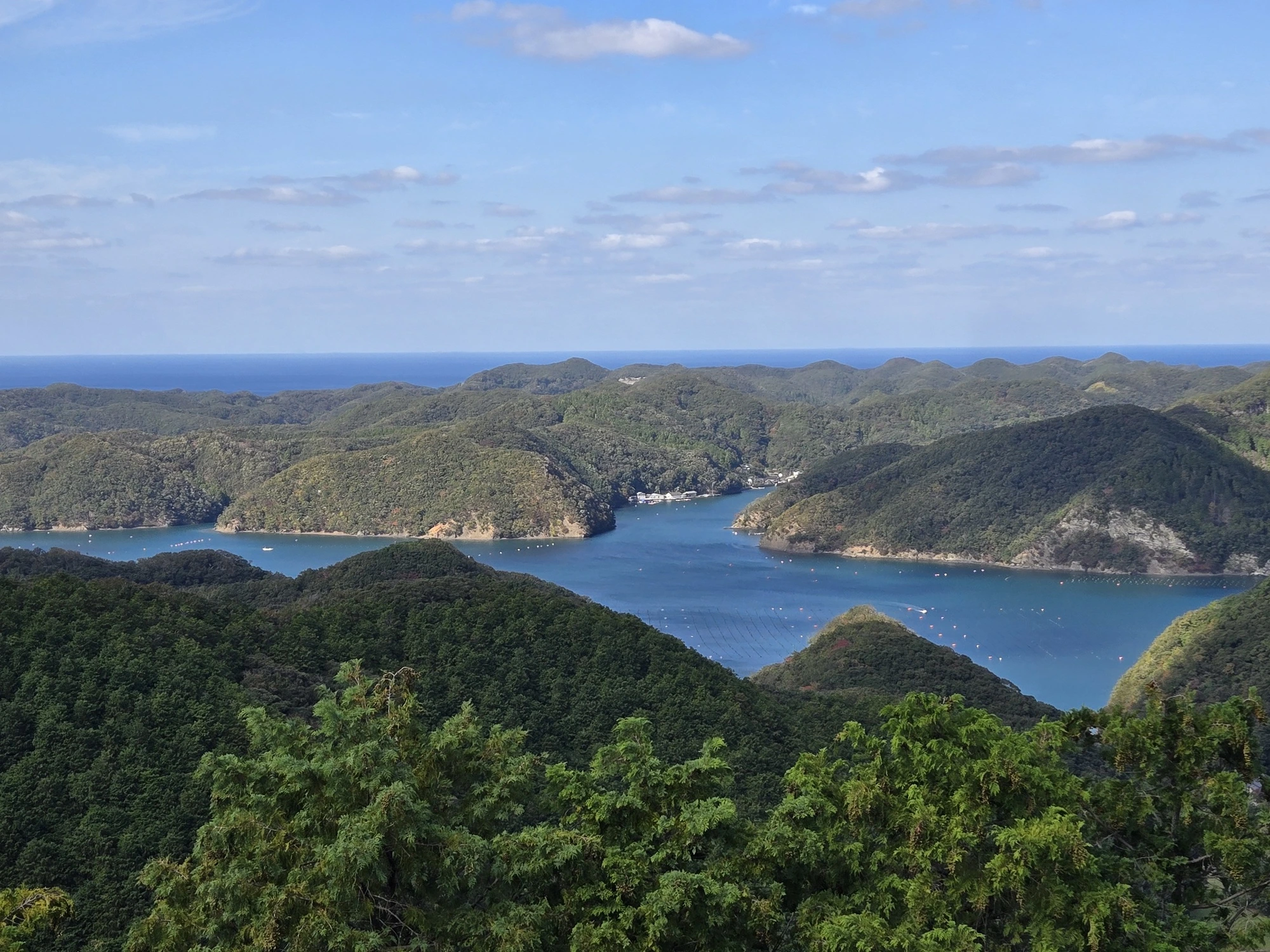
On a crisp, cool fall morning, we arrived at the Kitamura Pearls Oyamakoshi Farm on Tsushima Island, Nagasaki Prefecture. This is one of the largest pearl farms on the island and one of the oldest as well.
Established in 1901, the farm produces exquisite cultured Akoya pearls, both white as well as its signature ‘Tsushima blue’ pearls. Today, Mr. Yusuke Chikazawa, President of Kitamura Pearl Co. Ltd. and fifth generation pearl farmer, leads the family business.
The Akoya pearl industry in Japan consists of three distinct segments: farming, processing and wholesale, and retail. Kitamura Pearls is one of the few companies that touches all three segments.
Boarding boats, we were taken to visit different parts of this working pearl farm. This included visiting the buoys, where the real magic was taking place.
Pearl farms grow oysters in specially constructed panel nets. These panel nets are suspended from buoys, which keep them afloat underwater.
The buoys, attached to long ropes, stretched into the distance. At any one time, the farm has different areas designated for oysters of different ages, ranging from baby oysters to 1-, 2- and 3-year-olds as well as bead-nucleated oysters in their fourth of fifth year of life. Even a brief visit to the buoys gave us some idea of the scale of this commercial pearl farm and the intricate planning required to run it efficiently.
Another fascinating part of the farm was at the oyster cleaning shed. Oyster cleaning is an essential part of pearl farming. All oysters are periodically cleaned to remove barnacles and other parasites, which not only compete with the oysters for nutrients but also adversely affect their health.
At the Kitamura Pearl farm, we saw baby oysters being cleaned. Less than a year old, these baby oysters were small and delicate and required careful handling.
The baskets where the oysters were growing were carefully lifted out of the water. The oysters were then gently removed and cleaned by hand in a small tub of clean seawater. The baskets where the oysters were growing were carefully lifted out of the water. The oysters were then gently removed and cleaned by hand in a small tub of clean seawater. The baskets were also cleared of all debris before the oysters were replaced and returned to the water.
Later we visited a monument to the Akoya pearl oyster. Erected in the bay, the monument features a female deity holding an oyster with a gleaming pearl inside, honouring the life and sacrifice of the Akoya pearl oyster.
At the pearl farm, nothing is wasted. The pearls are used for jewellery, the shells for mother-of-pearl, and the adductor muscle as a fine-dining delicacy; even the oyster meat is composted. This nutrient-rich pearl compost is used in public parks and gardens on Mount Eboshi on Tsushima Island, which overlooks the farm.
As a result, the land becomes enriched with lush greenery. When it rains, nutrients from the soil are carried back to the sea, supporting the growth of healthy Akoya oysters, which in turn produce beautiful pearls. This virtuous cycle—known as Satoumi (from sato, meaning the area where people live, and umi, meaning the sea)—enhances biological productivity and biodiversity through a mutually beneficial relationship between human activity and nature.
Sasebo Pearl Farm

At the Sasebo Pearl Farm 
Wooden platforms suspended oyster panel nets 
An oyster panel net with Akoya pearl oysters 
A gorgeous Akoya pearl, just harvested, inside its shell 
A very skilled technician performing the delicate pearl grafting surgery 
Bead-nuclei used in pearl grafting 
Small pieces of mantle tissue from a donor oyster to be used in pearl grafting 
Mr. Fujita, CEO of Sasebo Pearl Company very graciously answering our questions 
The five guiding principles at Sasebo Pearl Company
Next on our agenda was a visit to the Sasebo Pearl Company. Sasebo Pearl Company is in the Nagasaki Prefecture and is one of the largest commercial Akoya pearl farm in the region. Interestingly, the farm is situated within a national park and is surrounded by mature trees and lush greenery. Nature is protected and a virtuous cycle of recycling and environmental sustainability is an essential part of life here as well.
At the farm, we met Mr. Fujita, CEO of Sasebo Pearl Company as well as Chairman of the Japan Pearl Promotion Society. Mr. Fujita started the Sasebo Pearl Company in 1966 and has been working with Akoya pearls for almost 60 years.
The bright fall morning started with a tour of the pearl farm by boat. Our stops included the buoys areas suspending oysters that has been nucleated 6 months ago as well as older oysters scheduled to be harvested in early 2026. This time round, some of the KOLSs pulled the panel nets out of the water and got an even closer look at the oysters.
After the boat tour, came the most exciting part – we were invited to harvest pearls. Harvesting pearls is like opening a mystery treasure box. You know you will find something special, but you can never be quite sure what it will be. Some of us harvested light blue pearls, others more creamier ones, and one KOL found a gleaming, round 10mm white stunner!
Next, we visited the pearl grafting workshop, where many skilled technicians were busy at work. Some were performing the precise and delicate surgery of cultivating the Akoya pearl oysters, while others were slicing the mantle tissue of donor oysters to be used in growing the pearl.
Historically, this process was a closely guarded secret. Even now, most commercial pearl farms do not allow visitors to see the actual bead-nucleation process. For this reason, it was a delight and an honour to be allowed behind-the-scenes and to see this integral part of pearl farming in person.
It was quite inspiring to watch the busy technicians performing their tasks. Many were so adept that it took them no longer than a minute to perform the surgery.
Thoroughly intrigued by the expertise of one of the technicians, I was informed that she had been working at Sasebo Pearl Company for fifty years! Here was a story of meticulous craftsmanship and dedication to perfection. But there was also a story of a company where employees spend decades growing with the company and becoming more like family.
After the tour, Mr. Fujita met with us to answer our many questions. He spoke at length about the principles that have guided him over the years. These included always taking care of the Akoya oysters because they are living beings, acting by putting yourself in the place of the Akoya oyster, being organized and encourage orderliness, morning and evening greetings for everyone, and honouring the balance and harmony between people, pearls and the planet.
Fukae Pearl Company

A group photo with the Governor of Nagasaki Prefecture, Mr. Oishi at the Fukae Pearl Company 
Exquisite multiciolour Akoya pearl necklace 
Exceptionally lustrous, top quality Akoya pearl necklace 
At the pearl grafting workshop at Fukae Pearl Company 
Governor Oishi understanding the pearl grafting process 
Governor Oishi performing the pearl grafting surgery
Next on our itinerary was the Fukae Pearl Company (and pearl farm), where we were graciously welcomed by the CEO, Mr. Kenichi Fukae.
Fukae Pearl Company is renowned for its award-winning Akoya pearls. A visit to their retail outlet quickly showed us why. With super-lustrous Akoya pearls set in a variety of jewellery pieces, the outlet was every pearl lover’s dream come true.
The highlight of this visit was meeting the Governor of Nagasaki Prefecture, Mr. Kengo Oishi, who had been informed of our pearl special tour. It was a great honour for all the KOLs and one of the most memorable moments of our tour.
During the farm tour, Mr. Oishi, who holds an MD, as well as a PH.D., met with the pearl grafters and, after receiving instruction, successfully performed the pearl grafting surgery.
Just outside the pearl grafting workshop, we saw saltwater tanks containing many oysters. These were special pre-operative oxidation tanks where the oysters rested before surgery. Similarly, there were dedicated post-operative tanks where the oysters recuperated after grafting.
Oysters require special care after the bead-nucleation surgery. As a result, the post-operative tanks contained a mixture of saltwater and natural salts to help the oysters heal.
At the Fukae Pearl farm, we met a number of young technicians, all extremely adept at performing the delicate grafting surgery. These included Mr. Fukae’s son and daughter. It was heartening to see the next generation continuing the legacy of Akoya pearl farming.
Pearl Farmers – The Unsung Heroes of the Pearl World
Pearls are often admired for their lustre, colour, shape and size. What is often overlooked is the hard work that goes into producing these gems.
Pearl farming is not for the faint hearted. It requires dedication, focus, resilience, and of course, a deep understanding of oysters and the beautiful pearls they produce.
In Japan, Akoya pearl farm operations are complex and multidimensional. There are oysters of different ages to care for, nucleation and post-nucleation management, oyster cleaning, general equipment upkeep, pearl harvests and preparation for next batch of spat (baby oysters), among many other tasks. While the seasons dictate the work, it is relentless. And even with all this effort, there is no guarantee that a nucleated oyster will produce a pearl, let alone one of gem quality.
In addition, farmers have to contend with warming ocean temperatures, the threat of tsunamis and cyclones that can cause serious damage on the farms and infectious diseases among oysters than can completely devastate a harvest.
Once harvested, though, Akoya pearls are beautiful and the pearl farmers deserve full recognition for the skill and hard work that goes into producing their precious gems.
Nagasaki Atomic Bomb Museum


As part of our Japan tour, we also visited the Nagasaki Atomic Bomb Museum. Located very close to the epicenter of the devastating atomic explosion, the museum meticulously documents the events leading up to August 9, 1945. It also displays heart-breaking remnants of lives lost, in that one moment, 11: 02 am, when the world changed forever.
Walking through the exhibits, I was constantly struck by the fact that no material, organic or otherwise, withstood the explosive power of the atomic bomb. The visit to the museum was a sobering reminder that achieving and maintaining peace, above all else, should be the goal of all human endeavor.
To reach the museum exhibits, you descend several stories along a spiral path. This downward journey serves as a metaphor, a walk back in time to the day of the blast. It is both symbolic and immersive. Every exhibit documents the horrors that followed the atomic blast. It is no surprise, then, that Japan remains fully committed to a world without nuclear wars.
But emerging from the museum and seeing the thriving Nagasaki city, with its tall buildings, busy streets, and fragrant bushes of orange osmanthus blooms, was very uplifting, a true testament to the strength and resilience of the Japanese people.
Featured Image: A view of the Kitamura Pearl Farm from Mount Eboshi, Tsushima Island
