
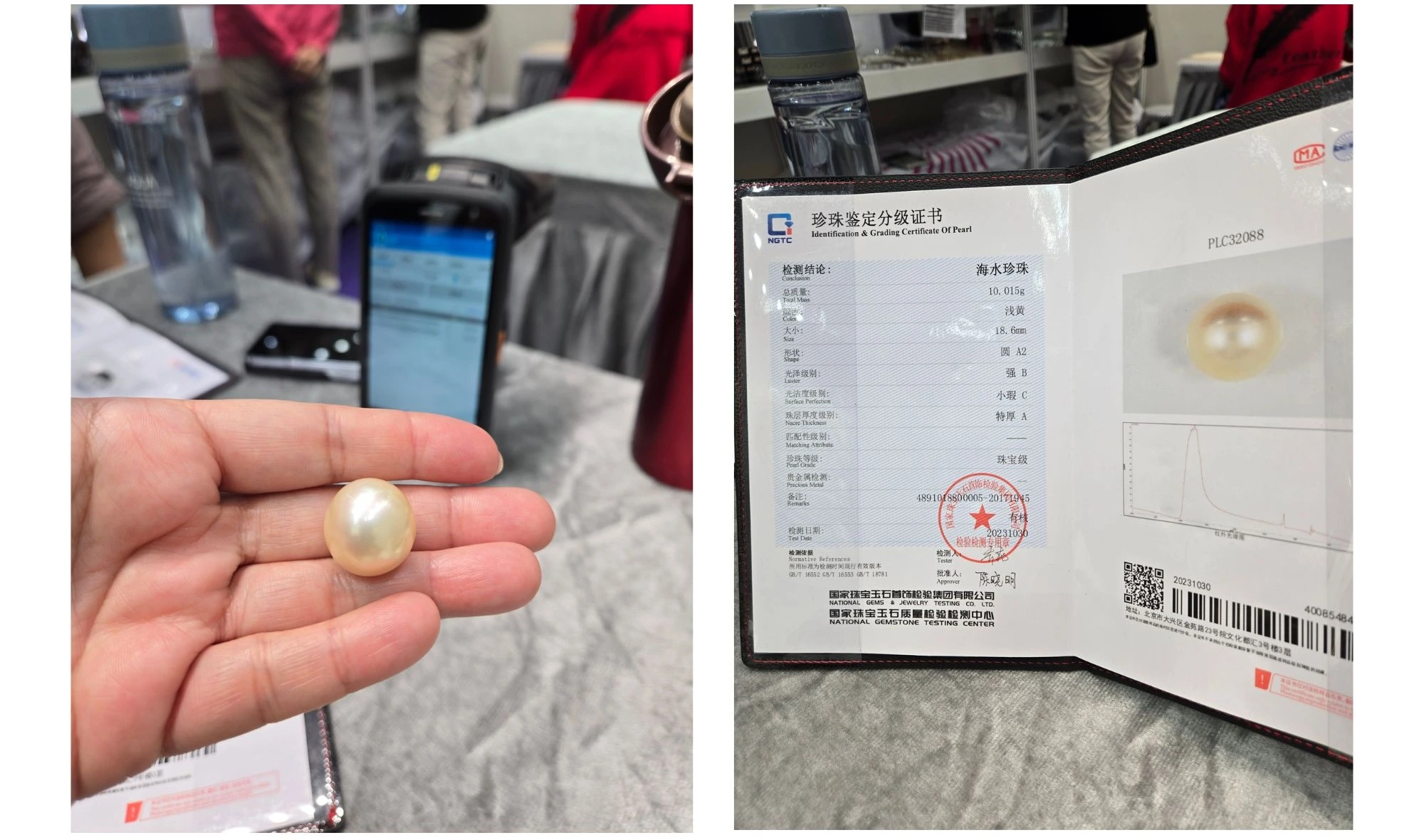
Pearls are simply fascinating. One of the most storied and coveted gems in the jewellery industry, their organic origins make them truly unique. However, it is also relatively easy to manufacture imitation pearls and pass them off as real.
It is also possible to misidentify pearls. For instance, a white Indonesian South Sea pearl can easily be mistaken for a white Australian South Sea pearl. Given the significant difference in the value between the two, a customer may unwittingly end up pay much more, or far less, than what the pearls are truly worth.
As a result, accurately distinguishing real from imitation pearls, as well as attributing the correct country of origin to pearls, is essential. RFID-chipped pearls offer an innovative and efficient solution, giving each cultured pearl its own unique ID.
Metakaku® is a patented, award-winning RFID- based pearl identification technology that was developed by David Wong, Project Director at the Fukui Shell Nucleus Factory more than a decade ago. Wong has long been associated with the cultured pearl industry and possesses a deep understanding of the global pearl market.
As a result, he was able to identify a gap in the market for the full traceability of cultured pearls. In 2012, he launched Metakaku® and, three years later, harvested the world’s first RFID-tagged Akoya pearl in Hong Kong.
All bead nuclei with Metakaku® technology are laminated. High quality, 128-bit EPC Gen 2 RFID chips are embedded inside the beads during the lamination process. The lamination is executed to very high technical standards, ensuring that the RFID-chipped beads are robust and durable. As a result, they can withstand the pearl culturing process and remain submerged in water for long periods of time as the pearls grow, without deterioration.
However, beyond the technical aspects of Metakaku® lies a deeply human story that began with identifying a problem and led to the introduction of a practical and efficient solution. On the surface, Wong’s work has involved embedding a chip inside a pearl bead nucleus and then successfully culturing it. Yet this innovation goes beyond technology and touches the very heart of transparency and traceability in cultured pearls, while strengthening the long-term credibility of the pearl trade itself.
I recently had the opportunity to catch up with David Wong. In our conversation, we discussed the story of Metakaku®, its reception in the pearl and jewellery industry and what he believes will be the enduring legacy of this technology.


Looking back, what personal moment or realization made you feel, “This is a problem I must solve for the pearl industry”?
My career in the cultured pearl industry began in the pearl nucleus manufacturing and supply sector. Through conversations with my father and with pearl cultivators from around the world, I absorbed countless stories—tales of formidable challenges along the value chain, and also inspiring accounts of the harmonious collaboration between nature and human ingenuity.
Yet one enduring dilemma has persisted since the dawn of civilization: distinguishing genuine pearls from imitations. Even today, the market still grapples with questions of provenance, authenticity, and what is truly “real.”
Amid these timeless pearl-related questions, one realization struck me very deeply: people have the right to know the full story of their pearls. Not just whether they are real, but where they came from, who cultivated them, and what kind of waters and communities are behind them.
That was the pivotal moment when I felt, “This is a problem I must solve for the pearl industry.”
What drew you to RFID for the Metakaku Technology in pearl bead nuclei? Did you experiment with other identification methods? What made them less successful than RFID for the cultured pearl industry?
My first introduction of RFID was in 2009 when I read the news about Hong Kong International Airport using the RFID tag to track the travellers’ baggage. The main problem I found was that all the tags were still considered too big. My goal was to find a tag that was small enough to place inside one pearl nucleus under the condition that it wouldn’t affect the pearl quality and the pearl cultivation process.
As I was a believer of the Moore’s Law (twice the amount of processing power under the same size every 2 years, but this law is about to be obsolete by around 2036), so I put my faith that there would be an RFID tag small enough to satisfy my need. I was correct and I found the tag (a size of 2.5mm x 2.5mm).
There were many other options available, including but not limited to molecular printing, NFC, dye, metal plating, and many more. However, they all came with some sort of limitations.
For NFC, the tag was too big and the reading efficiency was too low to be deemed user-friendly. Finding the “sweet spot” for reading the tag successfully would require quite a bit of patience.
For dye, metal-plating or molecular printing, they are applied at the pearl nucleus level. However, when the pearl layer covers up the pearl nucleus, reading or identifying such special marking require extra effort.
The RFID tag solves all of the above except for one down side, which is discouraging the drilling of the pearl as there is indeed a chance of breaking the tag upon drilling. However, this chance decreases as the pearl gets larger.
Metakaku® goes to the heart of transparency and traceability in the pearl industry. From your perspective, why are transparency and traceability becoming essential for cultured pearls and for the global jewellery industry today? What larger industry shifts are driving this need?
I sometimes receive enquiries from the most unexpected countries—governments and institutions exploring pearl cultivation for the first time. When more and more countries start showing interest, clearly there is something about pearls that goes beyond just making money.
As I dug into the global histories and cultures of pearls, and read research on mollusks in different parts of the world, a simple pattern emerged: when there is water, there are mollusks; where there are mollusks, there is always the possibility of pearls.
If we look into the future of the pearl market and imagine each country growing its own pearls, the real challenge becomes: how can they differentiate their pearls? In that scenario, transparency and traceability become more than just identification tools. They carry greater significance: to share each country’s history and culture, to reflect its environment and waters, and to let the world see the human and ecological stories behind each pearl.
From another perspective, I also create school curricula that enable students to learn the arts and sciences of the cultured pearl industry. They grow pearls in eco-tanks at school and then harvest them to create their own accessories. With Metakaku® and social media, these young “cultivators” can be seen and heard. Their pearls carry their stories.
In this way, the cultured pearl industry is expanding beyond the traditional boundaries. This grassroots involvement is democratizing the industry, making pearl cultivation accessible to more people and communities than ever before. In such a landscape, transparency and traceability are no longer optional add-ons—they become essential foundations.
You have been working with many saltwater and freshwater pearl farms to successfully grow pearls with Metakaku® technology. How did these collaborations come about? Did you face any challenges in creating these partnerships with pearl farmers? If so, how did you overcome them?
The collaborations in the beginning were very exploratory. The model was simple: we supplied Metakaku®, and the pearl farmers grew the pearls. We were still trying to come up with a proper operating model that worked for everyone.
Of course, there were challenges. We faced rejection, we lost track of some pieces, and there were even cases of thievery. But an interesting thing happened: gemmological laboratories started announcing that they had discovered Metakaku® pearls embedded in strands they were analyzing.
Instead of feeling negative, it was more like a parent discovering that a long-lost child is still out there in the world, safe and alive. It showed that the pearls—and the idea—were moving through the industry, even if we did not control every step.
So we kept going. We refined our approach, accepted that not every partnership would work out, and waited and worked for the right timing and the right partners to emerge..
What was the first successfully harvested cultured pearl embedded with Metakaku® technology? What emotions did you experience when you first saw that pearl?
The first successful harvest of a Metakaku® pearl happened in Hong Kong in February 2015. It was significant not only because it carried the technology, but also because it marked the first time in over a decade that Hong Kong had grown its own pearls again.
However, this first harvest was not carried out by humans, but by nature itself.
There was a red tide event involving Heterocapsa circularisquama, which killed all of our pearl oysters. When I heard the news, I felt helpless, but at the same time, I was strangely at peace. When we went back to the pearl farm the next day, we found that the pearls were there—the pearls had been harvested, but not by human hands.
That moment was a very clear affirmation for me: I had to revive the cultured pearl industry of Hong Kong. It was as if nature had given us both a warning and a blessing at the same time.
How has the jewellery industry welcomed this innovation, and what reactions have been most encouraging to you?
The jewellery industry’s response was mixed. Some people approved, some rejected it, and some remained neutral. That is normal for any new technology that challenges long-established ways of doing things.
But the greatest acceptance has actually come from those outside the traditional jewellery sector.
Professionals from different fields such as technology, education, sustainability, and impact investing, understand the technology but see Metakaku®’s value proposition and potential in very different ways. It is their questions, feedback, and ideas that have inspired breakthroughs and opened doors to new opportunities.
These opportunities expand the value proposition of pearls themselves, beyond luxury objects, into symbols of collaboration between nature, technology, education, and community.
What has this journey taught you about patience, given that pearls themselves take years to grow?
For me, this patience is about proactive waiting. I don’t just sit and let nature work on its own. While I trust nature to do the cultivation inside the oysters, I keep moving outside the water, communicating the story, meeting people, and building relationships.
The responses I receive, from encouragement to criticism, can all be turned into fuel for moving forward.
Patience has taught me to be hopeful, faithful, and humble. It has also taught me that a steady process of growth is always better than one big launch with nothing to follow up. The completion of each small step, each small experiment or project, really adds up over time.
In that sense, patience is not passive. It is an active discipline of walking step by step, in rhythm with the time it takes for a pearl to form.
As an innovator who has pushed the boundaries and taken the pearl industry to a new frontier, what projects or ideas are you focused on today, and what might we see from you soon?
Right now, I am actively introducing the cultured pearl industry into schools.
We don’t just teach about pearls as jewellery. We demystify them from the perspectives of both humanities and sciences. Students become caretakers of pearl oysters by growing them in their school’s eco-tank. Teachers from different subjects become their advisors and assistants.
Students then harvest their own pearls, design and make accessories, and learn how to market and sell them. All of this is done with one core mission in mind, to show them that we are all stewards of this planet.
In my imagination, this is a fun and meaningful way to transform my knowledge and experiences in the cultured pearl industry into a learning journey that reveals the wisdom and beauty of nature–human collaboration to the next generation.
I would love to see a future where, wherever there is water, present-day stories of pearl cultivation are being told. And who knows, maybe one day, someone in Antarctica will want to start exploring pearl cultivation there too.
Looking ahead, what legacy would you like Metakaku® to leave for the global pearl industry going forward?
Democratization of pearls is the vision behind Metakaku®. It embodies integrity, transparency, traceability, and justice.
By digitizing pearls, we enable the cultured pearl industry to become a proponent of the circular economy. Stakeholders and consumers can begin to see that pearls from a particular country actually involve many people and ecosystems from other parts of the world, such as oyster hatcheries, nucleus manufacturers, farmers, designers, retailers, and of course, the waters themselves.
From a personal perspective, I often think on a very human scale, wouldn’t it be wonderful if someone like Ms. Reema Farooqui, an ordinary person who is very passionate about pearls, could grow and sell her own pearls, with her story recognized and respected?
If Metakaku® can help make that possible, then I would consider that a meaningful legacy for the global pearl industry.
Featured Image: RFID-tagged, Loose Golden South Sea Pearl with Metakaku® technology
